Sunday, May 1, 2016

The White Picket Fence

Sitting near the edge, we killed flowers. Devilish chrysanthemums, lilacs, a terrible ocean of daffodils. These fleurs du mal, so to speak. We could see the window from where we sat, gleaming. Rork and I held scissors, and we were busy cutting the flowers. I can smell them still—they made my nose tingle and sniff, and Rork kept saying I’m so tired, I want to go back inside. Don’t forget to wash your hands after, I said—they might be poisonous. There was the smell of dinner, and the constant odor of dead plants, mixing in the humid, late afternoon air. Rork sighed again. We were almost done. I held up an orange bulb. Is that a tulip, I asked? Rork only shrugged, as he dug his scissors into the dirt. Beyond the white picket fence, I saw Adaline walking down the street with her dog. I thought of waving, but didn’t, only peering through the crack of the fence, letting my eyes linger for a couple extra seconds before returning to the tulip, still in my hand. Rork rose. I’m done, he said, fiddling absently with his scissors. Careful there, I said; why don’t you tell Kallie? I will. And Rork walked away, and went through the side door quietly. I stood up as well, looking across the street, to Mr. Edgar’s house, painted faded green. This is where the story begins.

Long ago, before I knew words, Kallie brought home Rork. Birch could not believe it, nor could he conceive of a future with this new reality in mind. He cursed Kallie and threatened to leave, but I can dimly remember him sobbing in the bedroom, helpless gasps seeping through the walls into my small room. Yet there could be no prolonged anguish in this neighborhood—the flowers in the yard prohibited it. Mr. and Mrs. Thresser prohibited it. Hans Hesov, Brich’s boss, would not allow it either. So Birch bit his tongue (quite literally) and accepted Rork into his sad, saddening life. Kallie saw this turn in Birch’s chronic mood, and felt sympathetic, though not quite sorry. Is there anything I can do? she asked meekly. No…not anymore, said Birch, with resignation. I was watching them three feet from the ground, barely able to understand, but I imagine my throat swelling with angst. Could I have done something? So it was, that while Rork and I played outside, while Kallie was out of town (presumably), Birch left. He took very little, and it was hard to tell if his life was one of those things he brought into his new existence. My next, fading memory viewed Kallie not sad at all, but eyes fixed while we were vacationing on a cool beach, eyes glazed so the horizon blurred into a wave—a wave that would carry us all away. Wouldn’t you like to go somewhere really really far away, she asked. I don’t know…I don’t know.

Rork threw a rock once. It struck me as it struck the tree, how hard he threw it. Rork was full of anger. Not the latent, self-loathing anger, but a very precise, maleficent attitude towards the living. The way he rejoiced at watching things decay…life is but the hell in which dead spirits are punished with, he once said. We must suffer so we can laugh when we see suffering. But he was surprisingly gentle in action, despite the things he said. He once asked me if I loved him. Like a brother, I said. Like Remus and Romulus? he asked. Yes, precisely, I replied. And we both laughed.

It became increasingly clear that something was going wrong, beyond the white picket fence where we inhabited. That other people saw us with minds slightly alien to ours. That the door into our house was uncanny. And the bedroom lights flickered when dogs walked by. Strange, was how people, homo sapiens, called the plot called 436 Ramsey St., the one with the white picket fence. How strange, how…different…But how all this was somehow wrong, and not simply different, came about in a somewhat peculiar manner. It involved bubbles. Blowing bubbles down the street, Adaline was humming too, with a couple of her school friends. I came up to her and told her I thought her dress was pretty. She stopped and blushed and smiled, but did not say a word. What are you up to? I ventured, but she lowered her eyes and began slipping away. Her friends did not see me, and I said: all bubbles pop eventually. (And yes indeed they do.)

We ended up bringing in some of the flowers, washing the dirt out and setting them onto the kitchen table, as Kallie had asked. Should we put them in a vase, or something? I asked. But Kallie was busy preparing dinner, and Rork had disappeared. The sun felt cold and gold, coming through the window. I waited there for several minutes, listening to footsteps, quick taps on the floor, an unsustainable rhythm.

There was the sound of bicycle gears turning outside. And a vague light, shining through the blinds, hitting me as I lay in bed. Sneaking outside, I saw Adaline, picking flowers. They’re evil, I said. So? she replied. Do you think I’m crazy? No. She held up a lonely rose. It’s beautiful, she said dreamily. The sun was going down, and the day worn out like an empty groan. Her eyes were deeply brown, and I could see that we loved each other. It was simple. There was a sheer impossibility to it that made me swoon. I reached out my hand; she took it. It felt soft, and wet with sweat. Nothing works out, she said. I know. The moon was in view, and I felt it pulling the tides in. My heart—

Then (days later) Rork went outside the fence, and screamed. Or rather he flew—flapping his arms, dancing with some sickening, incomprehensible purpose. With inexhaustible energy, to Kallie’s horrorstruck face, Rork went…and I, imagining Adaline’s reaction, smiled. Then I could hear people angry; they, brimming with vengeance, crying out for sympathy. Rork knew, and he flew. Alea iacta est, he said. Yes, yes, of course. I could smell something sweet too.

They eventually stoned Rork in front of the city hall. They brought stones and pebbles from the nearby Yornberg Creek, and tied him to a tree. After he was bloodied and unconscious, they gutted him and left him there, more or less. It was a crimson fest, it was cathartic, nasty, brutish, and the entire neighborhood felt exalted. I was there too, I thought of taking a video, but my mind was on something else, so I forgot. I saw roses in the background, dancing, laughing.

The Surrealism of a Red Painted House

In front was the entrance to a wonderful place. A door that welcomed without words. A driveway that curved without being abrupt. Seclusion in the most quaint sense, shifting quietly below the thin, tall trunks of aching trees and tired hills.

What made it so surreal? What made this place so…different? We entered and ashes floated. Dust grew like moss on tables. The air reminded me of a year that disappeared into the annals of slowly melted memory. What more could you say? Did we see ghosts? The answer is yes.

All we saw were ghosts.

By the time we arrived, the red paint had faded to a sad color that felt more maroon. It was flaking off so slightly, the the ground around was etched in a thin bed of red snowflakes. The whole place had cocooned itself to some other dimension, where time washed over more gently, more elegantly.

The first ghost I met was the mother. Who opened the door, which did not creak, who ushered me in with a warm hand on the shoulder. She said, ahhh, with a mild, surprised tone, yet so pleasurable. It’s you, she said. Nice to meet you finally. And a smell that I could not remember filled my lungs. I breathed in, tilting my head back a few degrees. The mother noticed and said, oh yes, but are you smelling the brownies, or death?

I sat after hesitating. You know where? I peered out the window and saw deer in the distance. Clouds vanished, and reappeared as dusk. Tea, or coffee?

This family of ghosts—the dusty afterthoughts of a faded nucleus. The mother came up to me holding a cup of tea, and thus began—

—many years ago, and I was still young, fresh, taken aback by such a proposal. But these moments are but “just another second” until eighty years later, and looking back, bring up vague notions and emotions, and like a stone in your shoe, nagging, making you ask, “why?” or “what if—” But I said yes, of course I did, and we moved in here before I became a woman. Before I could wake up and declare what the day would be. One day, very soon after we moved into this house, I had trouble falling asleep. And I just laid there, and he was so deeply asleep. There were creaking sounds that seemed to be coming from downstairs, and that was the first time I felt frightened, and truly alone. A sensation that has been mostly dormant since, but have come back, tickling the back of my neck, as you are right now…

I moved slowly through the living room, sliding my hand across the dry sofa. One of the daughters, whose face looked tired, ran past me and turned left onto the staircase upstairs. It appeared to me that the room was very dark, filled with empty thoughts—everything so old, even the light—when the father walked in, came up quickly and magnanimously as if to embrace me like a son, before pulling back and offering instead a firm handshake. I hope you don’t mind the current state of affairs…I’m afraid certain things are…irreversible, he said with a slight twinkle.   

The house was built in the first decade of the twentieth century. Young, perhaps, in comparison to the older, more rustic houses nearby, but its slow, understated presence gave it a sage-like aspect that came to grow, even as it was the home to a young, vibrant family. And it aged so wonderfully…like wine…like a healthy oak tree—casting down a cool shade, spreading life…

Their eldest son, looking in his early twenties, entered. He said: I thought you would come. I knew I would see you again. It was almost ten years ago—I don’t know if you remember, but we were in the city, walking around in the park, while it was raining slightly. You came up to me and offered me your hand. I took it, we walked, we danced underneath a grove of small trees, surrounded by a grove of steely skyscrapers, dancing to the rhythm of the afternoon traffic and the incomprehensible murmur of city life. The flickering of millions of lives, seeping through the autumn air through osmosis…

We went upstairs, to the master bedroom. See? A queen-sized bed, an elegant dark nightstand, a closet in the far corner. We won’t go inside, said the mother, passing through the wall. A picture hung next to where I was—a picture of paramount importance. It was black and white, an illustration of the entire family, stiff with forced smiles in front of the house. The moon glowed in the background. Ahh…that was taken in…

Shall we go outside?

A breeze softened the late summer heat. Deer floated far away, near the horizon. A garden, the source of life. Look at this tangle of…flowers. And the trees, which glowed with the living glare of liquid sunlight. The father pointed at one of the taller trees, about twenty feet in front. That is the oldest tree in town. See the black bit on its trunk, toward the ground? It’s been through several fires in its lifetime. It was here when angels and devils fought. This tree comes and goes with our thoughts on life. And as the leaves fall…could we not rake them into a pile, and pray?

Before leaving, the mother gave me a little gift, wrapped in rough, brown paper. Don’t open it yet…give it three days, at least. The road I took wandered away, and quickly the house of out of sight. As I rolled down the window, I could hear vague notions of whispers and the smell of the living room curling in. I breathed, wondering what the gift was, sitting in the passenger seat, illuminated by a red sunset.

Tuesday, April 5, 2016

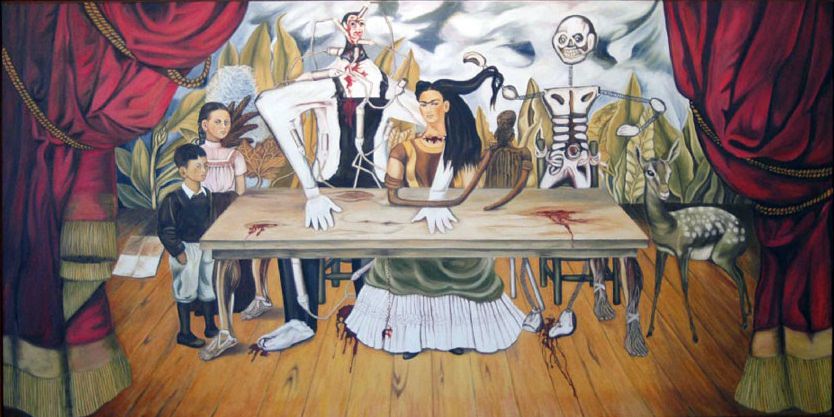
The Wounded Table, By Frida Kahlo

the-wounded-table.jpg

Dinner?
It’s your father.
Born out of the darkened pool of blood, dripping ceaselessly from the cold veins of your ancestors. Do you feel the wind?—it’s cackling—whipping the ground, knocking on your soul.

The ghosts will eat you now.

Where did the family go?
They went to Atlantic City, or somewhere across the border; perhaps a physical border, or something else—either way, gone from the land of mystic, dried skeletons, of grandpa’s moaning. Though the tapping from underneath the old, molded floor never stops, no matter what ground you step on.

Let us eat. Raise your glass to the decrepit, the never dead—to you.

You’re so young…such a pretty face to…to be eating from this table…soon it’ll…crawl away…all the food gone away…dragged into the mist…

Ha. But it’s all theater. Take off your mask, and you’ll see; the blood is fake. Fake as your steely, burdened body, fake as your tragic soul. And as the curtains come down, and you hear the roar of the crowd, then you’ll know you’ve been betrayed. And your hands will begin to wither, and you’ll grab at anything you can and see everything you’ve let die…oh woe is you—and me—and you—

Could you imagine breathing in this space? When I can only try and be the matriarch of this deserted family; whispering to these soulless objects, pass the salt, how was your day…and the emptiness starts to flood in when you’ve been replaced by the goblins and ghosts of all the sad men that lived in these streets for the last one hundred years.

Sunday, March 27, 2016

Dinner with Borges

We find ourselves in a dark restaurant, where the servers move silently and the food never comes. I take out a notebook, ready to take some notes. You say, gently, smiling, no need, no need. I ask you about your work. Generally speaking…

You say, ah, you see, it isn’t my work. It’s by Borges. I am confused by this response. I want to ask you again, but I am afraid of appearing silly. You see my confusion, and continue explaining: well, he is the one behind the writing; I, in front. But you must write; you are Borges, I say. No, no, no, you quickly retort; I am nothing but myself. Borges—he’s everywhere, but he isn’t here. You point at your left breast.

A server bumps into a table behind you, and spills some drinks. You turn around briefly. Hmm, unfortunate, your face seems to say, but what can you do. So what are you up to nowadays, I ask. Mostly just taking long walks, thinking about grand questions. There is so much left to do, but I find that without the urgency of death—what’s the rush? It takes a few seconds for that to sink in.

The check is brought over, even though we hadn’t ordered anything. I’ve got it, you say. Could I ask you one more thing, I say, hesitantly. You glance up, looking at me, behind me, with your blind, perceptive eyes. Ahh…

Imagine you’re on a long, long road, a dirt road going on forever across rolling hills, golden with tall grass and occasional windmills. You’re walking alone, or at the very least, riding a horse. You look up. The sky is blue. You think about your parents, you think about your back pain, you think about what you dreamt about last night, you think about all these things and more until you no longer remember where you are going, until you no longer realize that the landscape has become familiar, that you are in fact going in a big circle.

Sunday, March 13, 2016

Outpunched

Terver is portly, a sloth quite literally (in the new sense), caved over in his diluted work. The gleamed fan blades cut through the stench. Ah, there is some salvation, eh? Heime comes forth, holding a gold pen. Shouldn’t you be somewhere else? Ah, yes, ah… though is he really here in the first place? He contemplates picking up his tuna sandwich, half-wrapped in seran, half (or quarter) eaten, and does, then puts it back down—does?—oh yes, the Doctor said so. Urgent.
The carpet is matted with red spots, dulled out by years of Oxford shoe stamps, thudding in the case of Terver, occasionally gliding with young people. Shifts his plump hand under and around his chin, a rowdy 15 hour stubble… gosh gosh, rather late now. There are windows here, but it feels like nighttime. 6:21pm? Not quite, but—
Doctor: third door down the hallway to the left. After the Carpenter’s office. 104. Terver knocks twice before turning the handle, entering. Doctor: short, grey hair, strong cheekbones, clean-shaved, nicely ironed shirt—smells like Old Spice. Doctor: … hey, I’m going to have to… he knows, I know—the mahogany wood desk, drenched in paper piles and workplace residue. Doctor? He is now standing up, and here comes the firm handshake (eye contact in 3, 2, 1), calloused hands from (golf probably); the awkward 30 seconds before Terver is able to leave, listening to deep deep breaths, insistent mouse clicks—feverous email deleting, minesweeper… ?
Fuck. It’s raining hard, and it’s dark as hell. The windshield is as a tear swamped eye, cast under a dental light as oncoming traffic sweeps by. Trees are a-talking, a-gossiping with the grass, swaying, praying. He checks his phone at an empty stoplight. Does it flicker does it change? It’s both green and red—now purple!? His sedan goes though, through and through, coasting through the asphalt, the sorrowful air. Radio, on. The song goes like: [ ]


Home is a social construct, but Terver is in the frontyard, roaming sort of. Or just not going in. Wetness imbued within, nutritional (unless it is acid, but probably not), comforting… oh, you could sense a tingling in the ground, worms fleeing out of the saturated soil, ha fleeting fleeting annelids or whatever. See? Home is a construct. Rooted out by spring showers. Terver smiles. Fuck this shit. So alone. The T.V. is soon on, kept in company with Mr. Louis Trist of the local news station, part monotone, the rest oddly enunciated, a sad fellow, drooped eyelids, artificially neat hair. Terver sympathises, but only in his spare time, when the curtains are down, the beer is plentiful, and shit—oh pure, fresh-out-of-the-bowl explosive shit—is all over the week’s agenda. Otherwise, Mr. Trist is but another head, ahead and drifting in and out of netherworlds and mystifying memories (old, Freudian dreams?), while Terver is fantasizing about this and that, thither and thather. Thoughts crammed into a wooden broom in the closetspace of a closed drawer, dusted, aged without care. Dream sequence #13:
Terver understands, if only at the most cerebral level. Underground, unspoken damp spaces created out of the stymied sense of feminized jobs: ay, when did men stop being men? The first punch is the fastest—right hook that carries with it 36 years of sweat and enough force to kill a baby—missing a few inches, slicing (more like ramming, if you know what I’m talking about) into the empty mildewy place. Before he knows it, Terver feels squeamish (blood blood blood)… no, but there’s definitely blood gathering up his left cheek; the warmth of a heat lamp pressed against—only the warmth though, no light, as black sweeps in gently as a blanket, billowing. What we talk about is the slow death of fast food: Tartrazine, Butylated hydroxyanisole (BHA), Propyl gallate, Triacetin, Caramel coloring…There’s no blood on his hands when he takes a gingerly finger to the impact spot. Mah dear, wherefore art thou? His socks are wet, and gross. Terver can’t reach them. If it—soreness in the left calf, moderate bruising in the back, shoulders, and face, jaw.
Reafmann would be disappointed. Reafmann is a friend, in the loosest sense; who has an AR-15 under his bed and drinks scotch with scrambled eggs for breakfast. “Some elegance with function, yeah?” No one says anything, other than the windows, vibrating with the gravity of silence, uproars of (    ) yah, Terver, wake up! The string comes into focus, the locus-pocus here now, the Doppler Effect finally audible, such a strange, unhinging, reverse hypnosis… waking, (or dying?)—
A moment of clarity descends like a snowflake, so rare this time of year. The sheets are damp with the morning fog, saturated with warmth and industrial sadness. Terver eats cereal (damp too), wishing. The pain is superficially gone; an ache though… farther down his spine… His ears perk up and thinks it’s rather early to be hearing sirens: almost half past 10. He forgot to put on his watch. His pants barely fit, ugh the weight thinggg… but he manages and after brushing his teeth his mind cuts through the humid gaseous density.
But his car won’t go fast enough. The motor cranks, hustling with the mechanic strain, the impatient hum, Terver’s insistent tapping on the wheel, an increasing rhythm, pa-ta, pa-ta, consumes into a downhill roll. At a stoplight, Terver looks out of the window and sees a face he recognizes. A face he can match no name to, but a face whose contour he has touched before, even kissed perhaps, in a dream or dreamlike state, found within a memory buried deep within some milky haze, that now, looking out, through a pane of glass, and then through another window, has been awoken to the forefront of his conscience. He blinks. A blink of bewilderment, of a wild activation within him that jolted his fat-lined fibers—shivers—a tingle… until the the light turns green and a gliding motion of normality comes back and catches his muscles just in time.
Moving out of his car, Terver exhales profoundly. Where am I? He walks through the opaque door—ding!—greeted by a luminous hallway and a woman walking by. Are you… ? Yes, I believe so. Aha, aha—her hair, he observes while following, is dark brown, curly and unruly. Within a room they now enter, Terver is asked to be seated on a large cushioned chair with silky armrests. He’ll be here shortly. Thanks.
When the door creaks open, Terver realizes that his neck has been cocked back, eyes drifting into the cosmic background of his own head (or maybe the bleakness of the ceiling)—jolts forward and before he can fully turn his gluttonous body around, a firm, calloused hand descends onto his shoulder, coaxing him to stay. Ah, Reafmannwhat a lovely new place, eh? Well, did the Doctor say anything? [   ] He found you out. Yes, but do I say it? Terver shifts uncomfortably, rotating his sweating ass towards the towering Reafmann… well, well, well…
Reafmann takes a sheet of paper out of a satchel, laid propped up against the chair back. Hands it to Terver. Gentlemen: look at this leaflet of ruin—the crown of the corporate guillotine. He knows about the Doctor. The Doctor knows about him. And what does he know? It’s one thing to steal, another to be stolen in the act, without knowing. Ah, Herr Doktor. Where have I gone?
Terver quivers, sweating.
Postmortem: we only made it so far. There was too much water (or was it acid?). It started flooding port side, 9:46pm, oh oh—when the floorboards began cracking, the engines groaned with desolation. Then the flames and cyclonic winds whooshing the crew towards Paradise. Say a prayer for your boy! He’ll be fuckin’ gone soon enough. O Lord, let my soul rise up to meet you as the day rises to meet the sun. Glory to the Father, and to the Son, and to the Holy Spirit, as it was in the beginning…

Sunday, February 21, 2016

Dialogues I-IV

I.
Don’t you, sometimes?
               Yes, indeed sometimes.
Roses are red,
Violets are violet…
               So is the sky.
Absolutely stunning.
                                    Mesmerizing.
God’s gift to the world.
                                    Beauty of science.
I’m hungry.
We should eat.
                                    But the…
Ahh yes, the…
                                    We should wait longer.
Yes we should.
                                    Should we wait then?
                                    Five minutes?
Three minutes.
                                    Four.

II.
I forgive you.
                                    Please don’t.
Why not?
                                    It is so cold in here.
It is colder outside.
The sun is outside.
                                    I can see the sun inside.
The light —
                                    Too bright.
I can’t see.
Help!
                                    No. Shadows in the way.
Move them then.
                                    I’ll try my best.
Thank you.
                                    That’s not a problem.
                                    We’re friends, right?
I forgive you.

III.
Hello.
                                    Hi.
I am you.
                                    So am I.
I am happy.
                                    I am sad.
There is silence.
                                    Shhhh….
I see red.
                                    It is an apple.
It is not an apple.
                                    It is blue.
Apple.
                                    Fruits of labor.
Reaping benefits.
                                    Sunrise to sunset.
I am tired.
                                    Good morning.
Good morning.
                                    Lovely moonrise.

IV.
Sing to me please.
                                    What would you like to hear?
Heal my poor soul.
My soul needs healing.
                                    Ok.
                                    It’s in A major.
Sing.
                                    [sings]
                                    .
                                    .
                                    .
My bones feel softer,
My muscles are not as tight.
                                    Is it better?
But my soul…
                                    You must sing to yourself then.
                                    I don’t think I shall be able to help.
Teach me a song.

Teach me how to heal a soul.